
If you’re missing a tooth (or several), you’ve probably already noticed it’s not just a cosmetic issue. A gap can affect how you chew, how you speak, how your bite feels, and even how confident you are in everyday conversations.
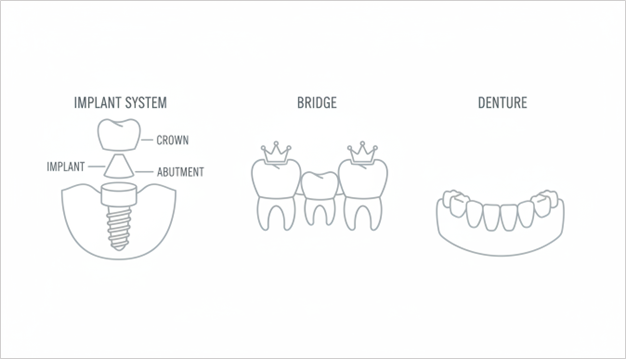
At CRIOS, we want patients to know they have options. Tooth replacement can be done with dental implants, bridges, or dentures, and each solution has a place depending on your goals, health history, timeline, and anatomy. That said, there’s a reason dental implants are widely considered the gold standard: the long-term advantages tend to be hard to match.
In this post, we’ll walk through the benefits of dental implants, explain how they work, and briefly compare them to bridges and dentures so you can make a confident, informed decision.
What Is a Dental Implant?
A dental implant is a small post—typically made of titanium or a titanium alloy—that we place into the jawbone to act as an artificial tooth root. After it heals and becomes stable, it can support:
- A crown (for a single missing tooth)
- A bridge (to replace multiple teeth)
- A full-arch restoration (for many missing teeth or full upper/lower replacement)
One reason implants are so effective is that they replace the tooth from the root up, not just the visible part. That root-like support is a big part of why implants look, feel, and function so naturally for many patients.
The Biggest Benefits of Dental Implants – the “Gold Standard”
When we talk about the benefits of dental implants, we’re not just talking about “having a tooth again.” We’re talking about restoring stability, protecting oral health, and choosing a solution that’s designed to last.
Benefit 1: Long-term durability and reliability
Dental implants are designed for long-term use. They’re built to handle the pressures of everyday chewing, and they’re not relying on neighboring teeth for support the way some other options do.
With proper placement, good home care, and regular dental checkups, implants can be a very durable solution. We never promise a lifetime guarantee—because health habits and medical factors matter—but implants are widely chosen because they’re often the most reliable long-term option available.
Benefit 2: Function that feels more like natural teeth
A common thing we hear after patients complete implant treatment is: “It feels like my tooth is back.”
That’s because implants are stable. They don’t shift like removable appliances can, and they allow you to chew more confidently.
Patients often appreciate:
- More comfortable chewing (especially with firmer foods)
- Less worry about movement or slipping
- A more natural feel in the bite
- Fewer speech concerns compared to loose dentures
Benefit 3: Jawbone preservation: one of the biggest reasons we recommend implants
This is one of the most important benefits—and one that’s easy to overlook.
When a tooth is missing, the jawbone in that area no longer gets the stimulation it normally receives during chewing. Over time, that lack of stimulation can lead to bone loss. In the long run, bone loss can affect:
- The strength and shape of the jaw
- The stability of neighboring teeth
- Facial support and appearance
Dental implants help address this by functioning like a root. They help transfer chewing forces into the bone, which supports healthier bone maintenance compared to leaving a space untreated.
Benefit 4: Protects neighboring teeth
When you replace a missing tooth with a traditional bridge, it often requires reshaping the neighboring teeth to support the bridge. That means healthy teeth may need to be altered—even though the issue is the missing tooth in the middle.
One of the major benefits of dental implants is that they don’t depend on neighboring teeth for support. That allows adjacent teeth to stay more intact, which can be better for long-term oral health.
Benefit 5: Aesthetics and confidence
A well-planned implant restoration can look extremely natural. Because implants support a crown from the inside (like a root), they often create a more tooth-like appearance—especially compared to removable options.
For many patients, the confidence side is huge:
- Smiling without worrying about a visible gap
- Talking without feeling self-conscious
- Feeling like they can “be normal” again in photos and social settings
Benefit 6: Oral health and hygiene can be more straightforward
Dental implants are typically cared for much like natural teeth: brushing, flossing, and routine dental visits. There’s no need to remove them for cleaning like a denture, and there’s no special adhesive routine.
And because implants stand on their own, they may reduce some of the hygiene challenges that can come with bridges, where plaque control under a replacement tooth can be more difficult.
Dental Implants vs. Bridges: What Our Patients Should Know
A dental bridge can be an effective option in certain situations. It typically works by anchoring a replacement tooth to the neighboring teeth on either side.
Why some patients choose bridges
- Can be faster in certain cases
- May not require surgery
- May be a good option depending on budget and tooth condition
Why implants are often preferred over bridges
When patients are deciding between the two, we often highlight these key differences:
- Implants don’t require altering neighboring teeth
- Implants help preserve jawbone, while a bridge does not stimulate the bone in the same way
- Implants can be easier to maintain long-term in many cases
- Implants are often more predictable over the long run, especially if adjacent teeth are healthy
That said, the right choice depends on your mouth—not a general rule. Our job is to help you understand which option fits your situation best.
Dental Implants vs. Dentures: What Patients Should Know
Dentures have helped many people restore function and appearance over the years, and for some patients they remain a reasonable option. But traditional removable dentures can also come with challenges, including:
- Slipping or shifting while eating or speaking
- Sore spots from friction
- Needing adhesives
- Limiting certain foods
- Ongoing refitting as the jawbone changes over time
How implants can help denture patients
Many denture wearers come to us because they want more stability. In those cases, implants may allow for:
- Implant-supported dentures that snap or secure in place more firmly
- Fixed full-arch options (in appropriate cases) for patients who want teeth that don’t come out
Even a small number of strategically placed implants can dramatically improve denture stability in the right patient.
Who Is a Good Candidate for Dental Implants?
Many adults are candidates for implants, but an evaluation is essential. In general, we look at:
- Overall oral health and gum health
- Bone availability (and whether grafting may be helpful)
- Medical history and medications
- Smoking status (because it can affect healing)
- Commitment to hygiene and follow-up care
If you’ve been told you don’t have enough bone, that doesn’t necessarily mean implants are off the table. It may mean we need to explore options such as grafting, different implant strategies, or alternatives based on your anatomy.
What to Expect From the Implant Process at CRIOS
We find that the process feels much less intimidating once patients understand the steps. While every case is different, here’s the general flow.
Step 1: Consultation and imaging
We start with an exam, a detailed discussion of your goals, and imaging to evaluate bone and anatomy. In many cases, 3D imaging helps us plan implant positioning with precision.
Step 2: Treatment planning
We plan around:
- The number of teeth being replaced
- Implant position and spacing
- Your bite and function goals
- Whether grafting is recommended
- Sedation/anesthesia options when appropriate
Step 3: Implant placement
Implant placement is typically an outpatient procedure. Our team prioritizes comfort, safety, and a predictable surgical experience.
Step 4: Healing and final restoration
After placement, the implant needs time to become stable. Once healing is complete, the final tooth (or teeth) is placed—such as a crown, bridge, or denture solution.
Step 5: Maintenance for long-term success
Just like natural teeth, implants benefit from:
- Good home care
- Routine dental cleanings and checkups
- Monitoring bite forces and habits (like grinding)
Common Questions About the Benefits of Dental Implants
Do implants hurt?
Most patients find the procedure easier than expected. We focus on comfort during treatment and provide clear aftercare guidance to support healing.
How long do dental implants last?
Implants are designed for long-term performance, but longevity depends on factors like hygiene, health history, bite forces, and follow-up care.
What if I don’t have enough bone?
You may still have options. Imaging and evaluation help us determine whether grafting, alternative implant strategies, or other solutions make the most sense.
Are implants worth the cost?
Many patients view implants as a long-term investment because of their stability, function, and ability to support bone health compared to other options.
Bottom Line: Dental Implants Are a Long-Term Investment in Comfort, Function, and Oral Health
There’s a reason implants are widely considered the gold standard. When we talk about the benefits of dental implants, we’re talking about more than replacing a missing tooth—we’re talking about restoring function, preserving bone, protecting surrounding teeth, and supporting long-term oral health.
If you’re considering implants, our team at CRIOS is here to help you understand your choices clearly. We’ll evaluate your situation, explain what we see on imaging, and recommend a plan that fits your goals—so you can move forward with confidence.